
In the phosphorus and salt chemical industries, the application environment for geomembranes is described as “extremely harsh.” These industries not only involve chemical corrosion from strong acids and alkalis, but also face challenges related to osmotic pressure due to high salt concentrations and physical damage to the membrane material caused by crystallization.
Leveraging Geoleed’s 20 years of technological expertise and Sino-Japanese collaborative standards, we offer the following professional solutions to address the typical pain points of these two industries:
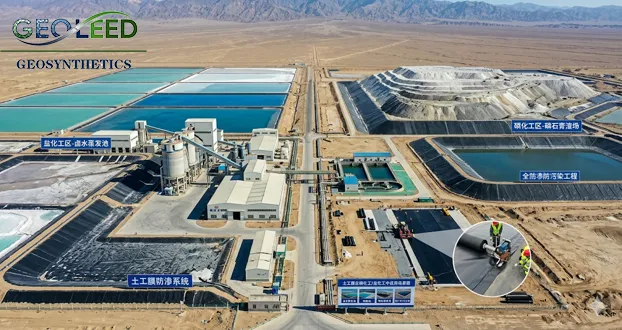
Core Application Scenarios in Phosphate Chemical/Salt Chemical Industries
Phosphogypsum Storage Leakage Prevention: Phosphogypsum contains acidic substances (phosphoric acid, fluorosilicic acid, etc.), resulting in leachate with extremely low pH values, posing a significant threat to groundwater.
Phosphate/Salt Chemical Wastewater Ponds: Storing high-concentration production wastewater in complex environments with fluctuating temperatures.
Salt Fields/Brine Ponds: Operating in highly saturated brine environments for extended periods, requiring protection against the physical friction of salt crystals on the membrane surface.
Evaporation Ponds: Utilizing sunlight to evaporate moisture, demanding extremely high UV resistance and heat aging resistance from the membrane material.
⚠️ Core Industry Pain Points and Geoleed Solutions
1.Strong Acid and Alkali Corrosion: Chemical Stability
Challenge: Phosphate chemical wastewater is highly acidic. Geomembranes produced from ordinary recycled materials are prone to molecular chain breakage in acidic environments, leading to membrane embrittlement and cracking.
Geoled Advantage: We use 100% virgin high-density polyethylene (HDPE). Because HDPE molecular chains are non-polar, they possess extremely strong chemical inertness, resisting corrosion from strong acids, strong alkalis, and organic solvents.
2.Environmental Stress Cracking Resistance (ESCR)
Challenge: Salt chemical ponds are often vast. If the geomembrane’s stress resistance is insufficient when subjected to the osmotic pressure and foundation settlement caused by high salt concentrations, stress cracking will occur at welds or corners.
Geoled Advantage: Based on Sino-Japanese cooperative technical standards, our ESCR performance far exceeds international standards (such as ASTM D5397 standard values). This means that the membrane material can maintain its flexibility and impermeability even under long-term stress.
3.High Temperature and UV Aging
Challenge: Evaporation ponds are typically located in areas with abundant sunlight, and the surface temperature of the black membrane can reach over 70°C after absorbing heat. Thermo-oxidative aging accelerates membrane failure.
Geoled Advantage: We have added 2%-3% nano-grade carbon black and a special antioxidant system to our formula. This “Sino-Japanese formula” effectively blocks UV degradation of the polymer chains, ensuring a service life of over 20-30 years in extreme outdoor environments.
4.Crystallization Damage and Physical Abrasion Resistance
Challenge: When salt crystals precipitate, the particles are sharp, causing frictional wear on the membrane surface under the action of water flow or wind.
Geoled Advantage: Our membrane material has extremely high physical strength (puncture resistance and tensile strength). For ponds with steep slopes, we recommend using Geoled textured membranes to increase friction with the substrate and prevent membrane tearing caused by crystal accumulation and slippage.
Geoleed’s technical support recommendations
| Key Indicators | Industry standard | Geoleed Standard |
| Raw Materials | May contain recycled materials | 100% New Virgin Material |
| Exercises Stress Cracking Resistance (ESCR) | 300-500 hours | ≥ 1000 Hours |
| Oxidation Induction Time (OIT) | 100 minutes | ≥ 150 Minutes |
Customer Benefits:
Eliminate chemical leaks caused by impurities
Protect foundation settlement and ensure no cracking for 20 years
Longer lifespan in high-temperature wastewater environments