The Future of Soil Stabilization
About Geomembrane
GEOSYNTHETIC MATERIAL SERVICE PROVIDER
Home » About Geomembrane
GeoLeed Geomembrane
- HDPE Polymer Geomembrane
- Product meets stringent GRI-GM13 international certification
- Applications in landfill, mining, and water conservancy
- Excellent anti-aging and UV resistance
- One-stop service from product to technology
GRI-GM13 is currently the most stringent and authoritative international technical specification for high-density polyethylene (HDPE) smooth geomembranes. It not only specifies physical properties but also sets extremely high requirements for durability and raw material formulation.
Geoleed’s GM13 certification is equivalent to obtaining an “international engineering passport” for its product. It signifies that this geomembrane is a top-tier impermeable material specifically designed to address the needs of high pressure, strong corrosion, and long service life.
GEOMEMBRANE STANDARD
| GeoLeed—Geomembrane ASTM D Standards | |||||||||
|---|---|---|---|---|---|---|---|---|---|
| Properties | Unit | Test Method | Product Specification | Frequency | |||||
| GL75 | GL10 | GL15 | GL20 | GL25 | GL30 | ||||
| Thickness | mm | ASTM D 5199 | 0.75 | 1.00 | 1.50 | 2.00 | 2.50 | 3.00 | Per roll |
| Density | g/cc | ASTM D 1505/D792 | 0.94 | 90000kg | |||||
| Tensile Properties | kn/m kn/m % % | ASTM D 6693 Type IV | 11 | 15 | 22 | 29 | 37 | 44 | 90000kg |
| yield strength | 20 | 27 | 40 | 53 | 67 | 80 | |||
| break strength | 12 | 12 | 12 | 12 | 12 | 12 | |||
| yield elongation / break elongation | 700 | 700 | 700 | 700 | 700 | 700 | |||
| tear Resistance | N | ASTM D 1004 | 93 | 125 | 187 | 249 | 311 | 374 | 20000kg |
| Puncture Resistance | N | ASTM D 4833 | 240 | 320 | 480 | 640 | 800 | 960 | 20000kg |
| Stress Crack Resistance | hr. | ASTM D 5397 | 500 hr. | per GRI GM-10 | |||||
| Carbon Black Content | % | ASTM D 4218 | 2.0-3.0% | 9000kg | |||||
| Oxidative Induction Time | min | ASTM D 3895 ASTM D 5885 | 100 min. | 90000kg | |||||
| (a)Standard OIT | |||||||||
| (b)High Pressure OIT | 500 min. | ||||||||
| Oven Aging at 85°C retained after 90 days | % | ASTM D 5721 ASTM D 3895 ASTM D 5885 | 55% 80% | per each formulation | |||||
| (a)Standard OIT-% | |||||||||
| (b)High Pressure OIT-% | |||||||||
| UV Resistance High Pressure OIT-% retained after 1600hrs | % | ASTM D 5885 | 50% | per each formulation | |||||
| Melt Index, condition 190°C/2.16kg | ASTM D 1238 | 0.20g/10min | |||||||
WHAT TYPE OF GEOMEMBRANE SHOULD BE CHOSEN?
| Product | Smooth Geomembrane | Single-Sided Textured Geomembrane | Double-Sided Textured Geomembrane | ||||||||||
| Introduction | This is the most basic and widely used type. | One side is rough (with a grainy or uneven texture), and the other side is smooth. | Both sides have a rough texture. | ||||||||||
| Features: | It has a smooth surface, uniform thickness, and good tensile properties. | The rough surface increases friction with the contact surface (geotextile or soil), preventing slippage. | It has the highest coefficient of friction and the strongest grip. | ||||||||||
| Advantages: | It is the cheapest, easy to weld, has high strength, and low water flow resistance. | It combines "anti-slip" and "easy welding". | It offers excellent stability, effectively "locking in" the overburden layer above the membrane and the underlying substrate. | ||||||||||
| Disadvantages: | It has an extremely low coefficient of friction, making it very slippery. | It is the most expensive, and relatively difficult to weld (the roughness at the weld seam usually needs to be ground off before welding). | |||||||||||
| Suitable Scenarios: | 1.It is suitable for projects on flat ground or with very gentle slopes (usually less than 10 degrees). 2.It is suitable for pond bottoms, artificial lake bottoms, and plain reservoirs. 3.It serves as the bottom layer of a lining (where it does not directly contact the sliding force). | 1.Landfill site slopes and landscape lakes with moderate slopes. 2.If you only need to address the slippage issue between the membrane and the underlying substrate (e.g., slope lining where the membrane rests on soil or geotextile mats), choose a single-sided textured surface. 3.Typically, the textured side is laid downwards on the slope to enhance grip; the smooth side faces outwards. | 1.Steep slopes (gradient greater than 15-18 degrees). 2.Landfill slopes: The membrane is topped with waste, and below it is sealing soil. Double-sided roughening prevents avalanche-like landslides of the entire structural layer. 3.Mine heap leaching sites: Locations requiring the ability to withstand immense pressure while maintaining the stability of the heap. | ||||||||||
| Features | Smooth face mask | Single-layer rough mask | Double-sided rough surface |
| Anti-slip performance | Poor | Medium | Excellent |
| Engineering slope | Flat ground or gentle slope | Medium slope | Steep slope |
| Welding difficulty | Easy | Relatively easy | Difficult (weld seams require treatment) |
| Material cost | Lowest | Medium | Highest |
| Typical applications | Lake bottom, pond | Landfill liner | Landfill/mine slope |
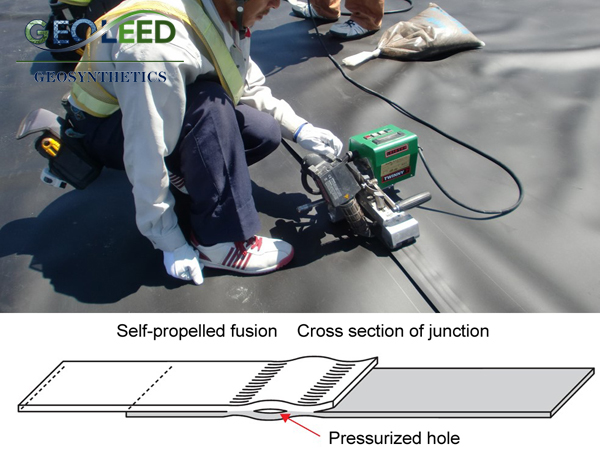
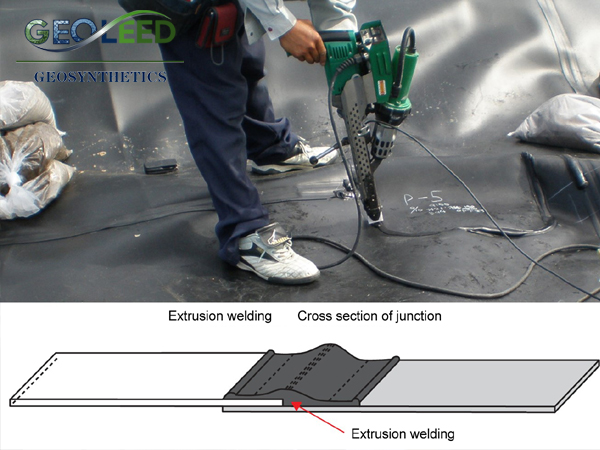
WELDING METHOD